
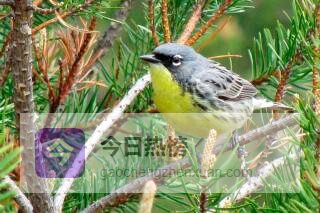
1 of 2 | A Kirtlands warbler in the jack pine forests of northern Michigan, near Mio, Mich., on May 19, 2008. (AP Photo/John Flesher File)
The US Forest Service is proposing a massive project in a national forest in Michigan that would log land roughly the size of Detroit, expand gravel mining and build roads.
The Silver Branch Vegetation Management Project would span about 40 miles from north to south on the eastern edge of the Ottawa National Forest in the western Upper Peninsula. The area along the border with Wisconsin includes habitat for the endangered northern long-eared bat , one of several reasons environmental groups have raised alarms about the project.
The multi-faceted proposal also includes a wild rice seeding project, improvements to campgrounds and lake access and attempts to bolster habitat for the protected Kirtlands warbler. The whole thing is projected to last around 30 years, with periodic reviews.
Unlike national parks, national forests serve multiple purposes. Theyre set aside for recreation, wildlife habitat and to provide timber. Ottawa National Forest officials say the Silver Branch project is not primarily about logging, its about getting the right tree mix for forest maintenance and health.
However, the project has drawn concerns from a wide range of groups, from environmentalists to off-roaders .
It involves 25,000 acres of national forest clear-cutting and yet the determination has been that there would be no significant impacts from such activities. Thats just not plausible, said Kelly Thayer, a senior policy advocate at the Environmental Law & Policy Center, a Midwest-based legal advocacy group.
That group and a loose coalition of organizations and businesses expressed concerns about the project in a letter and a 73-page document sent to the US Forest Service. Theyre worried that logging would spread invasive species, increase water runoff and impact habitat for protected animals found in the area like gray wolves and northern long-eared bats. They also dont like that trees more than 100 years old would be taken out.
The mature forest is most important for sequestering carbon and helping to stabilize our climate, Thayer said. Replanting with young trees in their place will not replicate the kind of benefits that the public receives now.
The groups want to see the project boundary changed to better preserve current and proposed protected wilderness areas . They also want to see an environmental impact statement produced.
The federal government already put together an environmental assessment and determined there would be no significant impact from the project. If the Forest Service pursued an environmental impact statement, it would need to answer tough questions about environmental concerns and potentially propose alternatives.
The Forest Service previously offered a 30-day comment period for the project beginning Dec. 23. Its planning to open a window for objections in March, though an exact date is not posted. Its currently anticipating making a decision on the project that same month.
If the project is approved, it is expected to begin in June.
The project as it stands involves a mix of logging: about 1,500 acres of clear-cutting and around 24,000 acres of a kind of clear-cutting that leaves certain trees. These sections are dispersed throughout the project area (see proposed north , middle and south maps). There would also be around 57,000 acres of other kinds of more-targeted logging. Add up the areas slated to have tree removal and they equal about 130 square miles.
The district ranger in the Bessemer, Iron River and Watersmeet Ranger Districts of the Ottawa National Forest, Trevor Hahka, told Bridge Michigan in an email its unclear how much money the project would generate from logging.
Revenue from timber sales depends on market conditions, he said.
Who would do the logging has not been decided but would be offered to private contractors through a competitive bidding process. Selected logging companies would then pay fees to the federal government for the timber they harvest and the companies would keep any profits. The money from the fees would go into federal accounts and not stay solely within the Ottawa National Forest. Contracts for gravel mining would also be competitively bid but the gravel would not be sold but used for Forest Service roads.
Hahka said the proposed logging is not the primary goal and restoring ecological balance to the woods is. He said there are too many hardwoods, aspen trees that are getting older than desired and conifers that are declining.
Active management in overstocked or aging stands prevents decline and promotes long-term forest health, he said.
The Forest Service, Hahka said, recognizes many of the concerns outlined by the coalition and have included measures to address them. He noted there are protective buffers around known northern long-eared bat roosts, theyre following best practices to reduce water runoff issues and limit the spread of invasive species, and that the project, through thinning and prescribed burns, would increase forest resilience to pests, disease and wildfire, issues amplified by climate change.
Thayer, with the Environmental Law & Policy Center, said that sometimes invasive species spread happens unintentionally during the logging process, when plants and seeds get stuck in equipment tread. He also pointed to findings in the Forest Services own environmental assessment that seemed to suggest some fire risk from logging:
There is a potential for the accrual of hazardous surface fuels after a timber harvest due to limbs, tops, and dead material within a stand after harvesting, the environmental assessment reads. This potentially heightens wildfire risk in stands that contain spruce and fir that have been affected by the spruce budworm and in areas with a heavy conifer component.
In response to the groups asks, Hahka said no activities are proposed in designated wilderness areas, but the Forest Service does not anticipate putting together a full environmental impact statement.
David Carter, a forestry professor at Michigan State University, said the Silver Branch proposal didnt really raise any red flags. He said it looked like a run-of-the-mill Forest Service project that involved some timber harvests, road maintenance and a lot of habitat restoration work.
He said Forest Service officials often become punching bags for people who have their hearts in the right place but who are misguided.
Its just so stinking hard to do the work, period, but let alone have the additional hurdle of people thinking youre trying to do harm to the landscape when usually its the exact opposite, he said.
Carter said that, when residents oppose projects like this, its mostly a not in my back yard-type situation.
Peoples demand for wood products has not gone down. It only goes up, he said. And so if we dont harvest it here, were just going to harvest it from somewhere else.
He said increasingly that ends up being places like Brazil, South Africa or southeast Asia, where the regulatory infrastructure is not what it is here in the United States.
___
This story was originally published by Bridge Michigan and distributed through a partnership with The Associated Press.
美国林务局拟在密歇根州一处国家森林推进大型项目,计划采伐面积约相当于底特律市大小的林地,同时扩展砂石开采并修建道路。
“银枝”植被管理项目将在上半岛西部的渥太华国家森林东缘南北延伸约40英里。这片与威斯康星州接壤的区域是濒危物种北方长耳蝠的栖息地,这也是环保组织对该项目提出警告的多个原因之一。
这项综合性提案还包括野生水稻播种计划、露营地与湖区通道的改善工程,以及为受保护的柯特兰莺强化栖息地的尝试。整个项目预计将持续约30年,并会进行定期评估。
与国家公园不同,国家森林具有多种功能。它们被划定为休闲娱乐、野生动物栖息地和木材供应区。渥太华国家森林官员表示,"银枝计划"的主要目的并非伐木,而是通过优化树种组合来维护森林生态健康。
然而,该项目引发了从环保人士到越野爱好者等众多群体的担忧。
这涉及2.5万英亩国有林的皆伐作业,然而相关评估却认定此类活动不会产生重大影响。这简直令人难以置信。”中西部法律倡导组织“环境法律与政策中心”的高级政策倡导者凯利·塞耶(Kelly Thayer)表示。
该组织及多个企业与机构组成的松散联盟在致美国林务局的一封信和一份73页的文件中,对该项目表达了担忧。他们担心伐木活动会扩散入侵物种、增加地表径流,并影响该地区受保护动物的栖息地,如灰狼和北方长耳蝠。此外,他们对砍伐树龄超过百年的树木也表示反对。
塞耶表示:“成熟森林对固碳和稳定气候至关重要。若仅以幼树重新种植,将无法复制公众当前所获得的生态效益。”
这些团体希望调整项目边界,以更好地保护现有及拟议的荒野保护区。他们还要求出具一份环境影响报告书。
联邦政府已完成环境评估,并认定该项目不会造成“重大影响”。若林务局继续推进环境影响报告,则需回应有关环境问题的尖锐质疑,并可能提出替代方案。
美国林务局此前为该项目的公众意见征询期设定为30天,自12月23日开始。该机构计划于三月开放异议窗口,但具体日期尚未公布。目前预计将在同月对该项目作出最终决定。
若该项目获批,预计将于6月启动。
当前项目涉及多种采伐方式:约1500英亩的皆伐作业,以及约2.4万英亩的保留特定树木的改良皆伐。这些作业区分散在整个项目区域内(参见拟议的北部、中部和南部区域地图)。另有约5.7万英亩土地将实施更具针对性的选择性采伐。所有规划采伐区域总面积合计约130平方英里。
渥太华国家森林贝瑟默、铁河及沃特斯米特护林区的护林员特雷弗·哈卡(Trevor Hahka)在给《密歇根桥报》的邮件中表示,目前尚不清楚该项目通过伐木能产生多少收益。
“木材销售的收入取决于市场行情。”他说道。
具体由哪家企业负责采伐作业尚未确定,但将通过竞标程序交由私营承包商承担。中标的伐木公司需向联邦政府支付所采伐木材的费用,企业可保留全部利润。这部分费用将纳入联邦财政账户,而非仅限用于渥太华国家森林。砂石开采合同同样采取竞标方式,但所采砂石不会对外销售,而是专用于林业局道路建设。
哈卡表示,拟议的伐木计划“并非主要目标”,恢复森林的生态平衡才是重点。他指出,目前硬木和山杨树的数量过多,且树龄超出预期,同时针叶树的数量正在减少。
他表示:“对过度密集或老龄化的林分进行主动管理,可防止其退化并促进森林的长期健康。”
哈卡表示,林业局已认识到联盟提出的诸多关切,并已制定相应解决措施。他指出,项目区域在已知北长耳蝙蝠栖息地周围设置了保护缓冲区,采用最佳实践以减少径流问题并限制入侵物种扩散。此外,通过疏伐和计划烧除等措施,该项目将提升森林对病虫害、野火等气候恶化加剧问题的抵御能力。
环境法律与政策中心的塞耶(Thayer)表示,在伐木过程中,植物和种子可能会无意间卡在设备履带上,导致入侵物种的传播。他还援引了林业局自身环境评估中的发现,这些发现似乎表明伐木活动存在一定的火灾风险:
环境评估报告指出:"木材采伐后,林分内残留的树枝、树梢和枯死物质可能导致地表可燃物堆积。这种情况会显著增加云杉冷杉林分的野火风险——尤其是那些已遭受云杉芽虫侵害的林分,以及针叶树密集分布的区域。"
哈卡(Hahka)回应相关团体的诉求时表示,目前未计划在指定的荒野区域开展任何活动,但美国林务局预计不会编制完整的环境影响评估报告。
密歇根州立大学林业学教授戴维·卡特(David Carter)表示,银枝计划“并未真正引发任何警示信号”。他认为这看起来是一项普通的林业服务项目,包括一些木材采伐、道路维护以及大量栖息地恢复工作。
他表示,林业局官员常常成为那些初衷良好但行为偏激之人的出气筒。
他说:“完成这项工作本身就非常困难,更不用说还要面对额外的障碍——人们总认为你在试图破坏环境,而事实往往恰恰相反。”
卡特表示,当居民反对此类项目时,通常属于“邻避效应”(NIMBY)的情况。
“人们对木制品的需求并未减少,反而持续增长,”他表示,“因此,如果我们不在这里采伐,就只能从其他地方获取。”
他愈发频繁地指出,最终往往是巴西、南非或东南亚等地成为选择,这些地方的监管体系与美国本土相比存在差距。
本文最初由《密歇根桥报》(Bridge Michigan)发表,并通过与美联社(The Associated Press)的合作进行分发。
原创文章,作者:梁雪莹,如若转载,请注明出处:http://m.gaochengzhenxuan.com/yule/7839.html
