

覃学苦练(90):精读期刊论文《区块链技术下考虑公平关切的竞争性供应链定价及协调策
03:28
来自LearningYard学苑
播放分享兴趣,传播快乐,增长见闻,留下美好!亲爱的您,这里是LearningYard新学苑。今天小编为大家带来文章覃学苦练(90):精读期刊论文《区块链技术下考虑公平关切的竞争性供应链定价及协调策略》分散决策(1)欢迎您的访问。Share interest, spread happiness,Increase knowledge, leave a beautiful!Dear, this is LearningYard Academy.Today, the editor brings you an article.Qin Xueku Lian (90): In-depth reading of the journal article "Competitive Supply Chain Pricing and Coordination Strategies Considering Fairness Concerns under Blockchain Technology" Decentralized Decision Making (1)Welcome to your visit.
一、思维导图(Mind mapping)
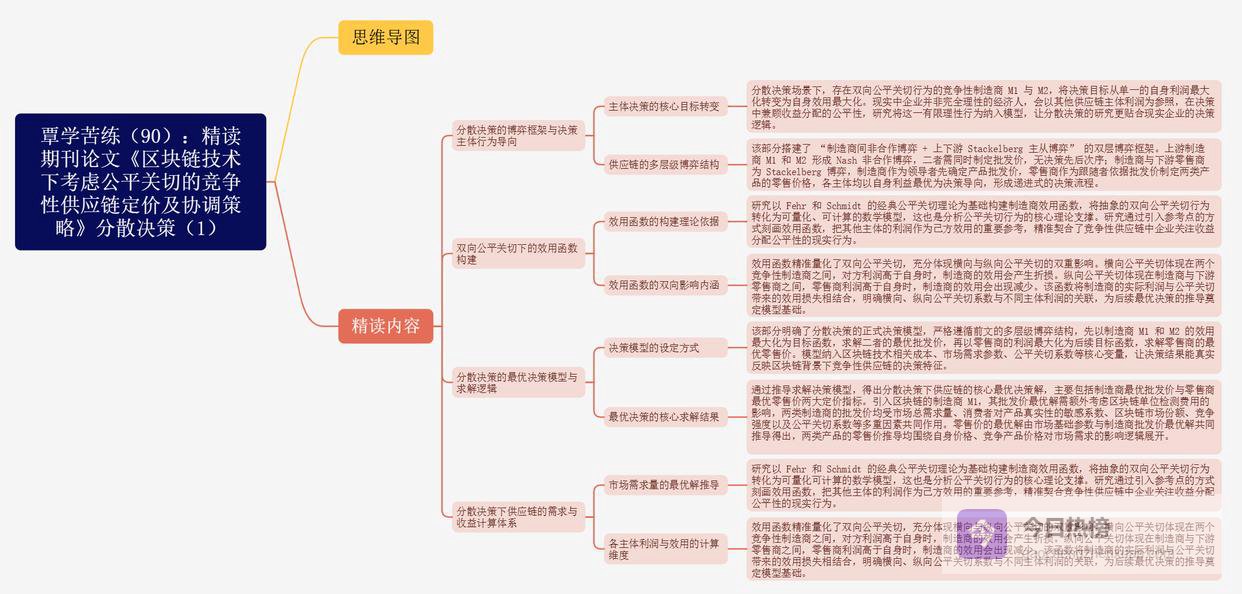
本文精读区块链技术下考虑公平关切的竞争性供应链分散决策双向公平关切部分,从博弈框架、效用函数构建、最优决策模型求解、需求与收益计算体系四大方面,剖析了该部分对分散决策下主体行为、模型构建、决策推导及收益核算的完整研究逻辑与核心内容。
This article provides a detailed analysis of bidirectional fairness concerns in decentralized decision-making for competitive supply chains under blockchain technology. It dissects the complete research logic and core content of this part regarding the behavior of subjects, model construction, decision derivation, and benefit calculation under decentralized decision-making from four aspects: game framework, utility function construction, optimal decision model solution, and demand and benefit calculation system.
二、精读内容(Intensive reading content)
(一) 分散决策的博弈框架与决策主体行为导向(The game-theoretic framework of decentralized decision-making and the behavioral orientation of decision-making entities)
1.主体决策的核心目标转变(Shift in the core objectives of decision-making)
分散决策场景下,存在双向公平关切行为的竞争性制造商M1与M2,将决策目标从单一的自身利润最大化转变为自身效用最大化。现实中企业并非完全理性的经济人,会以其他供应链主体利润为参照,在决策中兼顾收益分配的公平性,研究将这一有限理性行为纳入模型,让分散决策的研究更贴合现实企业的决策逻辑。
In decentralized decision-making scenarios, competitive manufacturers M1 and M2, exhibiting dual fairness concerns, shift their decision-making objectives from solely maximizing their own profits to maximizing their own utility. In reality, firms are not perfectly rational economic agents; they consider the profits of other supply chain entities as a reference, taking into account the fairness of profit distribution in their decisions. This study incorporates this bounded rationality behavior into the model, making the research on decentralized decision-making more closely aligned with the decision-making logic of real-world firms.
2.供应链的多层级博弈结构(The multi-level game structure of the supply chain)
该部分搭建了“制造商间非合作博弈+上下游Stackelberg主从博弈”的双层博弈框架。上游制造商M1和M2形成Nash非合作博弈,二者需同时制定批发价,无决策先后次序;制造商与下游零售商为Stackelberg博弈,制造商作为领导者先确定产品批发价,零售商作为跟随者依据批发价制定两类产品的零售价格,各主体均以自身利益最优为决策导向,形成递进式的决策流程。
This section constructs a two-layer game framework: "non-cooperative game between manufacturers + Stackelberg master-follower game between upstream and downstream." Upstream manufacturers M1 and M2 engage in a Nash non-cooperative game, where both must simultaneously set wholesale prices without any order of decision-making. Downstream retailers engage in a Stackelberg game in which manufacturers, as leaders, set wholesale prices first, and retailers, as followers, set retail prices for both product types based on these wholesale prices. Each entity prioritizes its own optimal interests, resulting in a progressive decision-making process.
(二)双向公平关切下的效用函数构建(Construction of the utility function under the concern of two-way equity)
1.效用函数的构建理论依据(Theoretical basis for constructing utility functions)
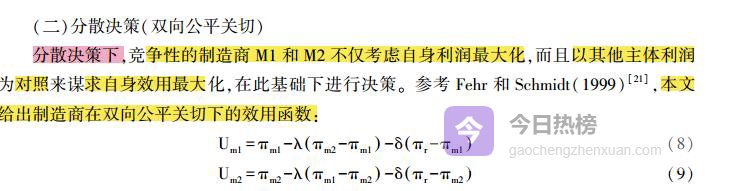
研究以Fehr和Schmidt的经典公平关切理论为基础构建制造商效用函数,将抽象的双向公平关切行为转化为可量化、可计算的数学模型,这也是分析公平关切行为的核心理论支撑。研究通过引入参考点的方式刻画效用函数,把其他主体的利润作为己方效用的重要参考,精准契合了竞争性供应链中企业关注收益分配公平性的现实行为。
This study constructs a manufacturer's utility function based on Fehr and Schmidt's classic fairness concern theory, transforming abstract two-way fairness concern behavior into a quantifiable and computable mathematical model. This is also the core theoretical support for analyzing fairness concern behavior. By introducing a reference point to characterize the utility function, the study uses the profits of other entities as an important reference for its own utility, accurately reflecting the reality of firms in competitive supply chains, focusing on the fairness of profit distribution.
2.效用函数的双向影响内涵(The implications of the two-way influence of the utility function)
效用函数精准量化了双向公平关切,充分体现横向与纵向公平关切的双重影响。横向公平关切体现在两个竞争性制造商之间,对方利润高于自身时,制造商的效用会产生折损。纵向公平关切体现在制造商与下游零售商之间,零售商利润高于自身时,制造商的效用会出现减少。该函数将制造商的实际利润与公平关切带来的效用损失相结合,明确横向、纵向公平关切系数与不同主体利润的关联,为后续最优决策的推导奠定模型基础。
The utility function accurately quantifies the two-way equity concerns, fully reflecting the dual impact of horizontal and vertical equity concerns. Horizontal fairness concerns arise between two competing manufacturers; when the competitor's profit is higher than the manufacturer's, the manufacturer's utility is diminished. Vertical fairness concerns arise between the manufacturer and downstream retailers; when the retailer's profit is higher than the manufacturer's, the manufacturer's utility decreases. This function combines the manufacturer's actual profit with the utility loss caused by fairness concerns, clarifying the relationship between horizontal and vertical fairness concern coefficients and the profits of different entities, laying the model foundation for the subsequent derivation of optimal decisions.
(三)分散决策的最优决策模型与求解逻辑(Optimal decision model and solution logic for decentralized decision making)
1.决策模型的设定方式(Methods for setting up decision-making models)
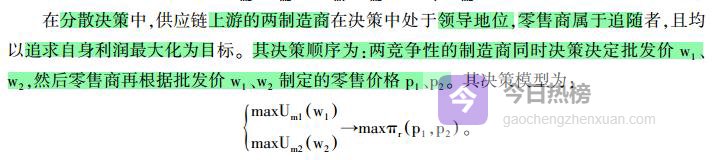
该部分明确了分散决策的正式决策模型,严格遵循前文的多层级博弈结构,先以制造商M1和M2的效用最大化为目标函数,求解二者的最优批发价,再以零售商的利润最大化为后续目标函数,求解零售商的最优零售价。模型纳入区块链技术相关成本、市场需求参数、公平关切系数等核心变量,让决策结果能真实反映区块链背景下竞争性供应链的决策特征。
This section clarifies the formal decision-making model for decentralized decision-making, strictly following the multi-level game structure described earlier. First, the optimal wholesale price for manufacturers M1 and M2 is solved by maximizing their utility as the objective function. Then, the optimal retail price for retailers is solved by maximizing their profit as the subsequent objective function. The model incorporates core variables such as blockchain technology-related costs, market demand parameters, and fairness concern coefficients, enabling the decision-making results to truly reflect the decision-making characteristics of a competitive supply chain in the context of blockchain.
2.最优决策的核心求解结果(Core solution results for optimal decision-making)
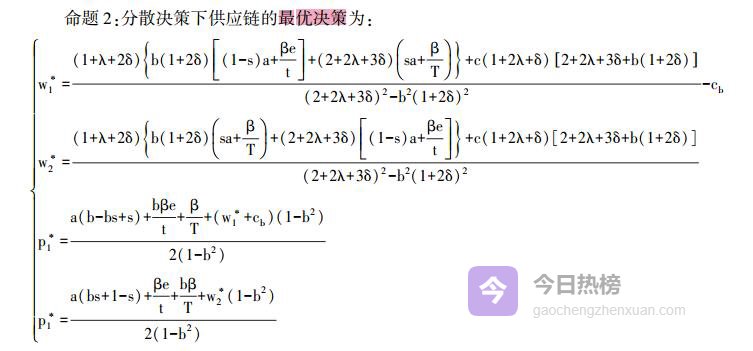
通过推导求解决策模型,得出分散决策下供应链的核心最优决策解,主要包括制造商最优批发价与零售商最优零售价两大定价指标。
By deriving and solving the decision model, the core optimal decision solution for the supply chain under decentralized decision-making is obtained, which mainly includes two pricing indicators: the optimal wholesale price of manufacturers and the optimal retail price of retailers.
引入区块链的制造商M1,其批发价最优解需额外考虑区块链单位检测费用的影响,两类制造商的批发价均受市场总需求量、消费者对产品真实性的敏感系数、区块链市场份额、竞争强度以及公平关切系数等多重因素共同作用。零售价的最优解由市场基础参数与制造商批发价最优解共同推导得出,两类产品的零售价推导均围绕自身价格、竞争产品价格对市场需求的影响逻辑展开。
For manufacturer M1, which incorporates blockchain technology, the optimal wholesale price needs to consider the impact of blockchain unit testing costs. The wholesale prices of both types of manufacturers are influenced by multiple factors, including total market demand, consumer sensitivity to product authenticity, blockchain market share, competition intensity, and fairness concerns. The optimal retail price is derived from both the market baseline parameters and the optimal wholesale price. The derivation of retail prices for both types of products revolves around the logic of how their own prices and the prices of competing products affect market demand.
(四)分散决策下供应链的需求与收益计算体系(Demand and revenue calculation system for supply chain under decentralized decision-making)
1.市场需求量的最优解推导(Derivation of the optimal solution for market demand)
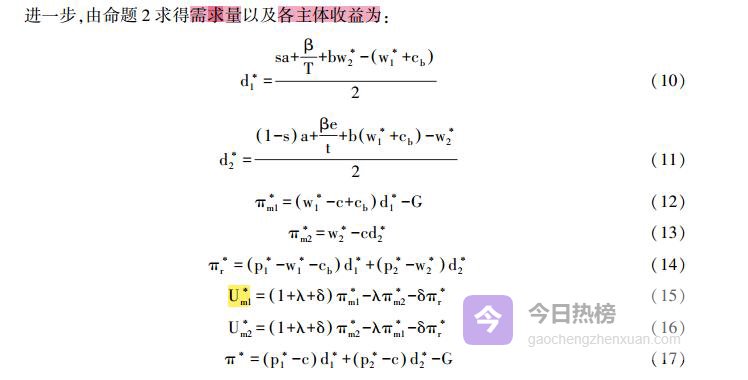
在最优定价决策的基础上,研究进一步推导得出M1和M2两类产品的市场最优需求量,需求量的计算紧密结合前文设定的需求函数,直接受区块链技术市场份额、消费者对产品真实性的敏感系数、产品批发价等核心变量影响,其中制造商M1的产品需求量还需考虑区块链单位检测费用的传导作用。市场最优需求量的得出,为后续各主体利润与效用的计算提供了关键基础数据。
Based on the optimal pricing decision, the study further derives the optimal market demand for two product categories, M1 and M2. The calculation of demand is closely integrated with the previously defined demand function and is directly influenced by core variables such as the market share of blockchain technology, consumers' sensitivity to product authenticity, and product wholesale prices. The demand for manufacturer M1's product also needs to consider the transmission effect of blockchain unit testing costs. The determination of the optimal market demand provides crucial foundational data for subsequent calculations of profits and utility for each entity.
2.各主体利润与效用的计算维度(Calculation dimensions of profit and utility for each entity)
研究构建了分散决策下供应链完整的利润与效用计算体系,覆盖制造商M1、M2 与零售商三大主体,同时区分实际利润与效用两个计算维度。
The study constructs a complete profit and utility calculation system for the supply chain under decentralized decision-making, covering three main entities: manufacturers M1, M2, and retailers, while distinguishing between two calculation dimensions: actual profit and utility.
利润维度中,制造商M1的利润需在批发价、成本、需求量的核算基础上扣除区块链技术一次性引入成本,制造商M2为常规的销售利润核算,零售商利润为两类产品的销售利润之和。
In terms of profit, the profit of manufacturer M1 is calculated based on the wholesale price, cost, and demand, minus the one-time cost of introducing blockchain technology. Manufacturer M2's profit is calculated using conventional sales profit accounting. The retailer's profit is the sum of the sales profits of the two types of products.
效用维度中,以制造商的实际利润为基础,扣除横向、纵向公平关切带来的效用损失,得出制造商的最优效用,实现对公平关切行为下企业实际决策收益的精准刻画。
In the utility dimension, based on the manufacturer's actual profit, the utility loss caused by horizontal and vertical fairness concerns is deducted to obtain the manufacturer's optimal utility, thereby achieving an accurate characterization of the actual decision-making benefits of enterprises under fairness concern behavior.
今天的分享就到这里了。如果您对文章有独特的想法,欢迎给我们留言,让我们相约明天。祝您今天过得开心快乐!That's all for today's sharing.If you have a unique idea about the article,please leave us a message,and let us meet tomorrow.I wish you a nice day!
翻译:谷歌翻译
参考资料:百度百科、Chat GPT
参考文献:林帅成,张桂涛.区块链技术下考虑公平关切的竞争性供应链定价及协调策略[J].经济与管理评论,2024,40(5):122-134.
本文由LearningYard新学苑整理发出,如有侵权请在后台留言沟通!
LearningYard新学苑
文字:qin排版:qin审核|qiu
原创文章,作者:孙杰,如若转载,请注明出处:http://m.gaochengzhenxuan.com/keji/4600.html